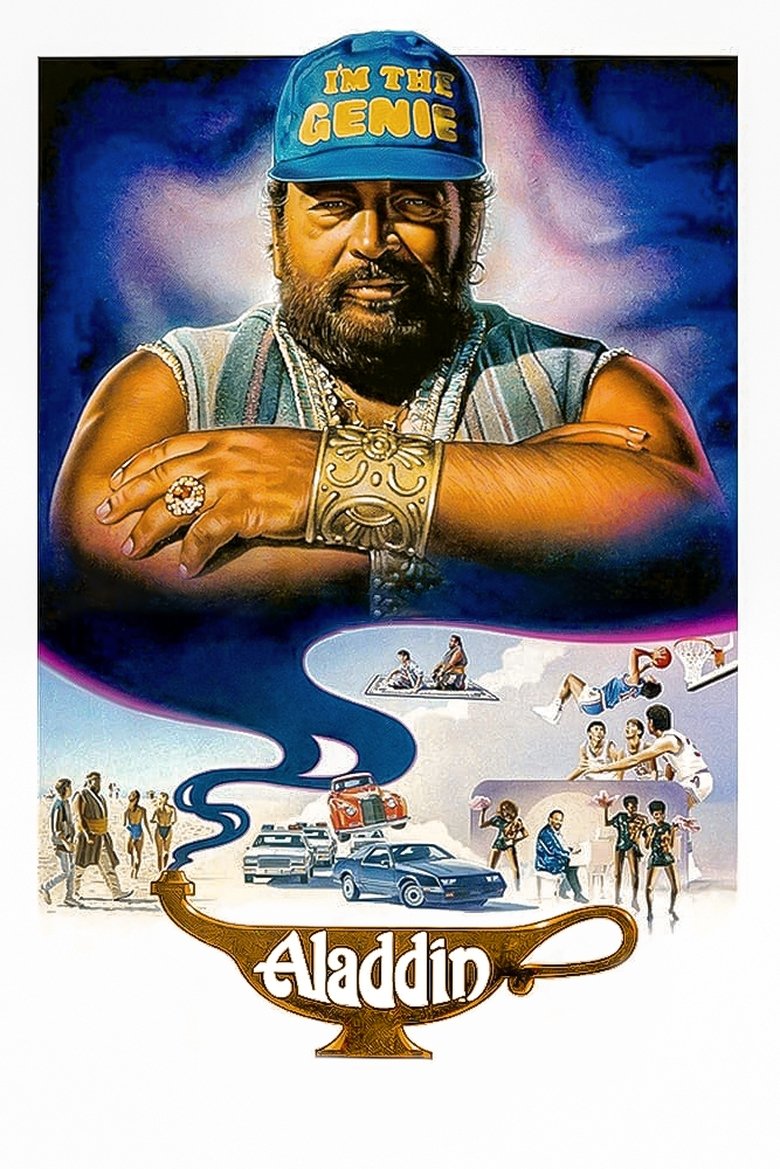
Aladdin (1986)
A Miami teen's discovery of a magic lantern unleashes a genie, offering adventure and wishes; perfect for fantasy fans.
Genres: Action, Adventure, Comedy, Fantasy
Cast
- Cast member 1
- Cast member 2
- Cast member 3
- Cast member 4
- Cast member 5
- Cast member 6
- Cast member 7
- Cast member 8
- Cast member 9
- Cast member 10

Your Status
Aladdin(1986)

Where to Watch
subscription




Free

Overview
In modern-day Miami, a teenager discovers a magic lantern and accidentally wakes a genie who has been asleep for centuries. Grateful and larger-than-life, the genie offers a handful of wishes, pulling the teen into a sunny, oddball adventure where everyday problems collide with daytime-only magic.
Insights
Review Summary
Pros: warm family-friendly tone; goofy wish-fulfillment fun; time-capsule Miami vibe | Cons: clunky-looking magic; uneven pacing; crime bits feel tacked-on
Will You Like This?
You’ll likely enjoy this if you want a light, quirky ’80s family fantasy with a sunny Miami feel and simple wish-driven comedy; Not for you if you need polished effects, tight plotting, or nonstop action like Banana Joe.
My Friends' Ratings
None of your friends have rated this yet.
Cast
Full Cast & CrewFeatured Comments/Tips
I discovered this film on the MOVIES! channel, a free, standard-definition channel w/ crappy commercials. So I knew this wasn''t the Walt Disney film; people pay good money to watch that. Boy is it weird. I''m also learning of the Italian actor Bud Spencer. I thought he died a long time ago but Spencer only passed on in 2016.
seedy italian movies shot in miami.
Featured User Reviews

**“Aladdin” (1986)**—better known in many places as **“Superfantagenio”**—is the kind of movie that strolls in wearing a “family fantasy” name tag and then immediately starts behaving like an ’80s oddball hybrid: part modern fairy tale, part Miami postcard, part low-budget magic show with a side of mild gangster nonsense. The premise is simple enough to fit on the back of a cereal box: a kid finds a lamp, rubs it, and out pops a genie—except the genie is **Bud Spencer**, which is like summoning a forklift when you asked for a party balloon. There’s also a built-in limiter: the magic works only in daylight, and at night the genie is basically off duty, which is a funny idea on paper and an oddly convenient way to avoid spending money on effects in practice. This is not classic Bud Spencer, and that’s the first thing that defines the “middle” impression. The usual expectation—big-hearted brute force, playful brawls, and that signature “I could fix this with one palm” energy—gets toned down. The movie wants to be gentler, cuter, more fairy-tale friendly, and it often keeps Bud on a leash. He’s still charming, still physically imposing, still able to sell a scene by simply standing there like a friendly wall, but the film doesn’t always let him do the thing he does best: dominate the rhythm. Instead, he becomes a strangely restrained guardian presence, half comedic sidekick, half magical babysitter, occasionally reduced to a prop that validates the kid’s adventure rather than driving it. And then there’s the look and feel: unmistakably ’80s, unmistakably “we’re doing this with what we’ve got.” The effects are… let’s call them honest. Flying carpets and magical moments arrive with the subtlety of a stage curtain being yanked by someone you can almost picture just off-frame. The charm here depends on tolerance for visible artifice. If the vibe of a cheerful Saturday afternoon TV rerun hits the right nerve, the clunky tricks become part of the appeal—like watching an enthusiastic school play where everyone’s trying hard and nobody is pretending it’s Broadway. If it doesn’t hit, the magic scenes can feel more like budget gymnastics than wonder. Structurally, the movie also struggles with what it actually wants to be. It bounces between whimsical fairy-tale beats and crime-adjacent shenanigans without always stitching them together smoothly. It’s as if the story is constantly rummaging through drawers: “We need danger—grab a gangster. We need comedy—throw in a wish. We need warmth—cue a bonding moment.” Some sequences sparkle with a goofy sincerity; others feel like filler that’s waiting for the next “big” idea to arrive. The pacing can wobble, and the plot progression often feels less like a clean narrative curve and more like a chain of loosely linked episodes. Still—here’s the thing—it has a stubborn, peculiar likability. The concept of Bud Spencer as a daylight-limited genie is intrinsically funny, and his presence gives the film a warm center even when everything around him wobbles. There’s also an undeniable time-capsule appeal: the fashion, the settings, the tone, the naïve confidence that a modernized fairy tale set in a sunny city can work purely on charm and momentum. And for all the rough edges, the movie rarely turns mean. It’s not cynical; it’s just uneven. It wants to entertain, it wants to be sweet, and it wants to deliver a handful of feel-good moments, even if the wrapping paper looks like it came from the discount bin. In the end, “Aladdin” (1986) lands as a mildly eccentric curiosity: **a family-friendly Bud Spencer detour that’s more endearing than impressive**. The best parts are the ones where the premise and Bud’s natural charisma line up; the weaker parts are where the film feels like it’s stretching a small bag of magic dust across a very large carpet. It’s not a disaster, it’s not a triumph—more like a wish that technically got granted, just with a few typos and a visible string holding the illusion in the air.