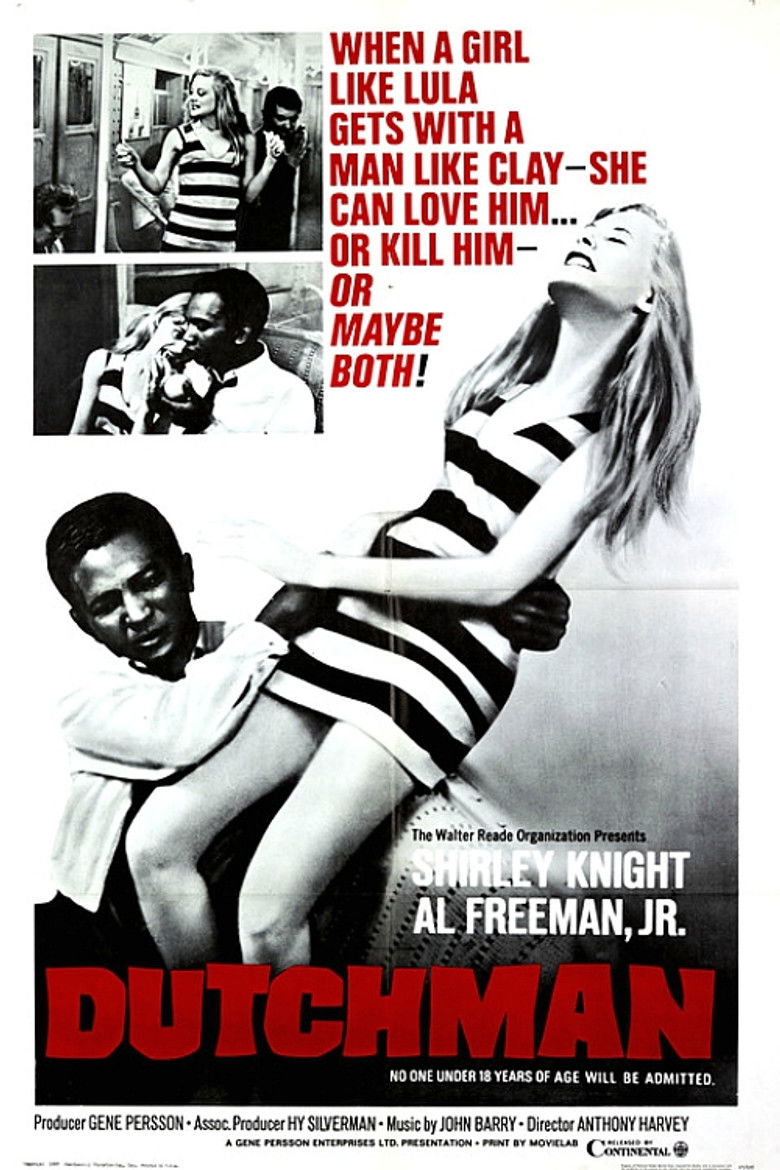
Dutchman (1966)
A tense subway encounter explores race, desire, and conflict. Perfect for fans of provocative, dialogue-driven drama.
Genres: Drama
Cast
- Cast member 1
- Cast member 2
- Cast member 3
- Cast member 4
- Cast member 5
- Cast member 6
- Cast member 7
- Cast member 8
- Cast member 9
Your Status
Dutchman(1966)

Where to Watch
We can't seem to find any streaming sources for Dutchman
Overview
A young conservative black man, minding his own business, rides a nearly empty subway car. The only other passenger, a blonde vixen looking for trouble, sizes him up. Sexual tension, racial bigotry and righteous fury collide in a razor's edge confrontation between this unlikely pair.
My Friends' Ratings
None of your friends have rated this yet.
Cast
Full Cast & CrewFeatured Comments/Tips
None of your fellow streamers have left comments/tips yet.
Featured User Reviews

*PLEASE NOTE* This isn't a review, but a written essay that I did for my University on the theme of 'race and gender in theatre'. I spent over three weeks researching and writing the essay, with no clear structure and no clue what am doing. By working overtime and finally submitting it as late as 9 AM! I sent off the essay a month ago and I was tempted to post it on here immediately, but waited to see what grade I got; if it's actually good then I would post it, but if not, then I wouldn't. So yeah, you can guess that it came back good just from me logging this in. I also recommend checking out The Dutchman. It's on YouTube for free. So here's the essay. Enjoy: Amiri Baraka’s ‘The Dutchman’ is a controversial and bold confrontation of black oppression that’s still being discussed today. Released during the time of racial prejudice that’s heavily rooted in the underbelly of American society. In this essay I will be focusing on the theme of race in the 1966 movie adaption of ‘The Dutchman’ by British director Anthony Harvey, and stars Al Freeman Jr. (as Clay) and Shirley Knight (as Lula). I will be focusing on five scenes in the movie that I believe to be important and compelling when presenting the theme of race. How the filmmakers manage to translate the original source material through camera framing, acting, tone, and even the title itself. I will also make connections back to Baraka original purpose in selected scenes of the movie. By presenting contextual details surrounding The Dutchman, with American history that helped to inspire Amiri Baraka to built and sculpt ‘The Dutchman’ for what it is today. Intertwining both realism and symbolic themes from personal experiences, and how the story hits close to our lives. The whole movie is told as a metaphorical piece that’s littered with references to the darkest times of American history. Scene One The movie opens up with a grainy black and white shot of an empty train station, with composer John Barry razor sharp chugging score playing in the background. What’s fascinating is how director Anthony Harvey sets the tone in the opening sequence by Lula’s first introduction through Clay’s window, as he gazes at her model posing beauty with a lecherous look. She’s framed as this appealing, and yet peculiar figure that gives the audience some suspicion, while not knowing the reason why yet. The train departs and the camera cuts inside the train with Clay, but the camera zooms out to reveal Lula in the background with her eyes still locked on Clay with an apple in hand. She slowly lurks closer to him like a predator targeting its prey, before she makes herself known to him. Another interesting choice is when the two meet on the train, there’s a subway pole that visually separates the two a part, which visually represents the segregation law of the divided cultures. The separation of people by race in public places due to the Jim Crow laws. The title itself also plays a crucial part in the story, as one can easily make the comparison to the legendary curse ship of the Flying Dutchman and the slave ships in form as a train. This relates to an essay journal by Hugh Nelson called ‘A Brief Ride on a Doomed Ship’, which he states that “It is my feeling that Jones had made complex use of the ‘Dutchman’ theme in converting it into modern myth.”, he comments on the ghostly passengers with, “the fact that even when present they do not speak, makes them seem as unreal as the ghost who the Flying Dutchman decks“ (pp.53-54). This interpretation helps make the story feel ominous by intertwining slave ships and the legendary ghost ship into the mix. Meaning that Lula is metaphorically the captain of the ship. She traps and tortures Clay with verbal abuse and sexual taunting as a way to peel away his blackness. Lula’s words are her whip, and Clay can only take a few lashes until he explodes. The filmmakers themselves share the same interpretation, because how they use the train setting in the film and giving the passengers an uncanny presence. When the vessel departs from the station and enters into the tunnel darkness, outside of every window is completely blackness, and not general tunnel darkness, just nothingness. As if the only thing that exists is the subway train. Harvey did this to make the audience feel obstruct and trapped by placing you in the perspective of Clay’s oppression. The audience fail to notice that the train hasn’t stopped as Harvey doesn't draw too much focus on that detail yet, and instead draws your attention to the writing and acting. Clay breaks the curse for a second later on in the story when he notices the sudden appearance of other people on the train and says “Hey, I didn’t even notice all these people got on” (31:31). Scene Two Lula offers Clay an apple and while at first he’s restrained, but eventually joins in by playing her game after he takes the apple. Now what’s compelling about this is how the apple (and orange later shown in the story) confers the idea of temptation as it’s carried out through Lula advances towards Clay, while also having a mythical sense to it. Now over the years people saw the apple as symbolism for religion, while also having a racial undertone. In George R. Adams analysis in “My Christ in Dutchman”, he states how the interweaving of religious references to the story with Adam and Eve, and how the story ties with Christian typology with the fall of Adam mix with black propaganda. With Clay being Adam and Lula being Eve. So Clay accepting Lula’s offer of the forbidden fruit foreshadows his fate later on in the story, and how Clay’s outburst was the cause of the forbidden truth in the fruit (Adams, 1971, pp. 55-56). This is a compelling interpretation because it demonstrates a biblical undertone that tells a tragic tale of a young man who stumbles into the temptation that will later becomes his downfall. However I feel like the inclusion of the fruit is more race-related than a religious subtext. I feel it’s a depiction of white society offering to African-Americans as a trap. In that instance he drops his post blackness because he doesn’t want to argue with such an offer. Baraka himself said that black Americans shouldn’t follow “white” standards of beauty and value, and to stop looking at white culture for acceptance in order to fit in. The religious interpretation of the fruit and the Eve-like character for Lula has interested Baraka in the past, but he has openly stated that he simply based the character on a white women living in his neighborhood in New York City who was mentally disturbed. A more sinister example of how the fruit relates to ‘The Dutchman’s’ history of racial violence is the song called ‘Strange Fruit’ sung by Billie Holiday, originally written as a poem by Abel Meeropol. Carvalho (2013) documents the song is a protest against lynchings on black man and women, and tells a story through lyrics about death and pain. Dead black bodies hanging from a tree and plucked away by birds similar to fruit. By accepting the apple, Baraka is saying that he’s forgotten his black roots, because how an offer that looks so promising can be so rotten on the inside. While eating the fruit, Clay is sucking up the blood soaked flavors of his ancestors beatings and abuse, all in form of apple seeds from Southern trees. Scene Three Lula immediately starts making assumptions about Clay through his appearance and race. She has knowledge and facts about Clay’s life which flabbergasts him due to how accurate the claims are. What’s important about this scene is how it highlights racial stereotyping from Lula’s knowledge of Clay's life. At first he believes that she might know some of his friends or family, but in reality she doesn't know a thing about him and her knowledge stems from her stereotypical beliefs on how she sees black people. Referring to him as a well known type and how she knows him in palm of her hand. In a snarky remark, she tells Clay “You look like death eating a soda cracker” (7:41). This insult is Lula regarding him as dull, as he somehow confirmed her beliefs that all black man are the same and calls him out for being fake with “soda cracker”, meaning white man in black dialect. She then ridicules Clay’s clothing and states how his grandfather was both a slave and uneducated, but Clay tries not to let that bother him until Lula calls him a “black n*****” which stuns him to the core. What makes this scene intriguing is how Clay’s suit represents both class and respect that suggests a successful job with great pay. Lula can’t see him as independent and how white society fears of being overcome by someone who doesn’t share the same skin color as them. When the first insult didn’t hurt Clay, she decided to dig deeper by peeling away his trick skin. The tragedy of Clay as a character is he doesn’t fight back as he feels some sexual affection towards Lula, despite the racial insults and constant harassment. One can argue how he might have acted differently if it was a man instead of an attractive woman. His sexual desires for what a random white women can offer to him becomes his biggest downfall, and easy to manipulated by the thing that hates his kind. The director also sawed this as a shocking moment and wanted to put emphasis on Clay’s reaction. He cuts to a close up of actor Al Freeman Jr. face where his playful smile slowly fades into a bewildered expression. Intended to capture the moment after it was just blurred out in order to place you in the shoes of Clay. The abrupt change in tone makes the situation even more uncomfortable. “And that you are free of your your own history. And I am free of my history” (23:51). By saying this she remarks that the horrors of slavery was a thing in the past. Although, it turns out their past believes and prejudice are still present. As Lula said earlier, she controls the world through her lies. Scene Four Lula and Clay playfully bond over a piece of orange, as the camera floats around them to reveal the sudden appearance of subway riders standing in the background. The camera stops on point at the same metal pole from act one, but now both of them are closer together, which is the directors way of showing the progression of Lula’s plan of manipulation. Lula mentions plantations and mistakes certain details that Clay corrects her on. The mention of plantations is significant, because his description of the place is from the perspective of the plantation owners rather than the African-Americans, as a way to mock Lula for her lack of knowledge of the horrors and suffering. “Plantations were big open whitewashed places like heaven and everybody on ‘em was grooved to be there. Just strummin’ and hummin’ all day - and that's how the blues was born” (37:49). In his explanation there’s a sad irony behind it, because life on Plantations was far from luxury. Slave Plantations had men, women, and children work in horrendous conditions. The slave owners would beat and whip the enslaved if it was believed that they were slacking at work (Rice,n.d.,Par 8). During this scene, actor Al Freeman glances down for a split second before returning back to her graze to explain the plantations is a telling sign that after accepting all the offerings that the white woman has given to him throughout the film, it would come with the pain of his ancestors oppressed spirits by accepting such offers. Dr. Joy DeGruy developed a theory called ‘Post Traumatic Slave Syndrome’, where survival and adaptive behaviors in slavery carries on for the next 300 years. It caused last longing trauma and there was no help for it. Both physical and mental scars that can’t seen (AJ+, 2019). What Clay is stating here is how the effects of black oppression from slavery transferred over decades. (Ukpokodu,2000, p.76) documents how the invention of the Blues was heavily rooted in the personal misery of black people, and the the best way to realise emotional tension through song to remain some dignity while resisting to their abuse. Lula then begins to call out Clay by exposing him in front of the other passengers for hiding his blackness in fear of other white people. She explodes into a chaotic fit by dancing wildly and tries to get Clay to dance with her by “rubbing bellies”. Clay refuses and begs for her to sit down. Baraka original intentions here is to demonstrate how out of touch white American’s are when it come to other cultures and only use their bias to make the judgement. The director thinks the same thing as he uses a point of view shot when Lula jumps on the seat and dances on the pole with the camera tilted down on Clay from her POV; allowing the audience to see her world and views on black people, which is weak and tiny. “Do the gritty grind, like your old rag-head mommy” (39:31). A head rag is an African tradition that symbolises wealth and social status as a sign of respect; similar to Clay’s suit, she derides any sense of dignity to the black community and thinks of them as second class. The line “Be cool. Be cool” (40:35), is basically her a way of saying that he knows how to be cool through a white mans words and clothes. She refers to him at point as Uncle Tom without realising the context behind the character. Thompson (2018) reported that Uncle Tom was a fictional slave character and for some people it summons up the image of an old black man worshiping the white man, but in reality was the complete opposite and over time has been falsely interpret. Scene Five Clay’s heated monologue is him stepping out of his white mask to lecture Lula how she knows nothing but luxury, and to let him be a fake white man. He wishes white people would embrace black people more than the culture. How white people who like Bessie Smith and Charlie Parker without realising what they are actually saying; similar to how the cakewalk dance was created. Ukpokodu (2000, pp. 73), documents that the “cakewalk dance” was made by African-Americans who parodied the mannerisms of Southern High Society, as revenge for the minstrel performance of Jim Crow. The dance was even performed for the masters who didn’t suspect they were being mocked. The camera cuts to the subway riders who are a mixture of black and white, all reacting to Clay’s outburst. The director is displaying a multicultural subway riders who are observers to Clay’s own demise. There are shots of black subway riders with eyes of long sorrow that felt every word that Clay said without them having voices of their own. The Caucasian passengers stare on with hollow shells of expressions to Clay’s words. The tone of the scene with all eyes on Clay heights the embarrassment of his outburst over Lula’s comments. So when Clay fastens up his tie and puts his suit jacket back on, he’s putting back on the white mask that he’s been wearing before in order to find some acceptance in this world. When Lula stabs Clay, Harvey shoots this scene with a close up on Lula’s monstrous face indicating that while Clay relieved his true colors, so does she. What’s so important about this moment is how Clay’s rant and out pour of repressed feelings quickly got silenced. Baraka has started that during 63’ till 68’ leaders who wanted peace and equality that supported the American Civil Rights Movement were all murdered in a span of five years. Those leaders were John F. Kennedy, Malcolm X, and Martin Luther King. This eerily relates to Clay’s death, because when the original play was in development in middle of JFK’s assassination in 63, Baraka saw how Americans would retaliate to change. When his corpse falls on top of Lula, which is when the white subway riders come to her aid after she commands them to get him off of her, but not the black subway riders as they remain seated, as they are metaphorically chained up against the walls of the vessel, and to watch their masters dispose the only person who spoke to them. The director frames this scene as Lula plays the victim in such away that it telegraphs the old Georgia saying “Stand your-ground” statute. A flaw in the rights of self-defense against possible threats as a license to get away with murder is more relevant than ever. These killings, especially towards black people eventually sparked a new movement known as ‘Black Lives Matter’ to end race-based discrimination. In her article, Shah reported that in February 2020, Ahmaud Arbery was murdered while jogging by an armed white father and son. The two men said their felt “threaten” by Arbery and were just following the stand-your ground law; a similar excuse George Zimmerman used after he shot and killed Trayvan Martin (Shah, 2020, para.15). So despite eyewitness being present at the scene to Lula’s crazy antics, but the only thing that will be talked about is how a dangerous black man assaulted white woman back into her seat, slapped her across the face, smacked a newspaper out of a mans hand, and barked insults to the passengers. Labeling Clay the dangerous one. Concluding that the cursed ship is doomed to sail in a endless cycle to demolish the black souls that boards it’s vessel. In conclusion, the fact that a story like ‘The Dutchman’, with it being 50 years old and yet still manages to astound audiences today speaks volumes on it’s uncomfortable relevance. Any form of discussions either good or bad, will only breathe new life into The Dutchman. It’s the strongest effort that any play has ever done by holding up a mirror at the lives of black struggle through the discrimination for decades, which director Anthony Harvey manages to bring those elements to the screen. The everlasting impact of Amiri Barka words that cries out for change and exposes the land of the free. Bibliography: Adams, G.R. (1971). “MY CHRIST” IN “DUTCHMAN.” CLA Journal, [online] 15(1), pp.54–58. Available at: www.jstor.org/stable/44321530?read-now=1&refreqid=excelsior%3A18739112a3bdcf2ebec283575886ca2e&seq=3#page_scan_tab_contents [Accessed 29 Apr. 2020]. AJ+ (2019) Post Traumatic Slave Syndrome. How Is It Different From PTSD? [Video] Available at: www.youtube.com/watch?v=Rorgjdvphek [Accessed 11/05/2020]. CARVALHO, J. (2013). "Strange Fruit": Music between Violence and Death. The Journal of Aesthetics and Art Criticism, 71(1), 111-119. [Retrieved May 11, 2020, from www.jstor.org/stable/23597541 Dutchman. 1966. [Film]. Anthony Harvey. dir. UK: Dutchman Film Company. Levi, A. (2014) Dutchman Full movie [Video]. Available online: www.youtube.com/watch?v=8VRoOAmtHsQ [Accessed 24/4/2020]. Rice, A (n.d.), Life on plantations, Available online: revealinghistories.org.uk/africa-the-arrival-of-europeans-and-the-transatlantic-slave-trade/articles/life-on-plantations.html [Accessed 11/5/2020]. Shah, K. 2020. Ahmaud Arbery: anger mounts over killing of black jogger caught on video. The Guardian, 6 May [Online]. Available at: www.theguardian.com/us-news/2020/may/06/ahmaud-arbery-shooting-georgia [Accessed 11/5/2020]. Nelson, H. (1968). LeRoi Jones’ “Dutchman”: A Brief Ride on a Doomed Ship. Educational Theatre Journal, [online] 20(1), p.53. Available at: www.jstor.org/stable/3204875?read-now=1&refreqid=excelsior:aa6c1b4ed5de9c6b8bd338ae800d99c1&seq=1#metadata_info_tab_contents [Accessed 1 May 2020]. Thompson, C. (2018) Dear white people: Stop using the term ‘Uncle Tom’. The Washington Post, November 16 [Online]. Available at: www.washingtonpost.com/outlook/dear-white-people-stop-using-the-term-uncle-tom/2018/11/15/8a68e9c0-e84e-11e8-a939-9469f1166f9d_story.html [Accessed 3/5/20]. Ukpokodu, I. (2000). African American Males in Dance, Music, Theater, and Film. The Annals of the American Academy of Political and Social Science, 569, 71-85. Retrieved May 07, 2020, from www.jstor.org/stable/1048811
You might also like...
All Night Long
1962
Yield to the Night
1956
Dr. Syn, Alias the Scarecrow
1963
Never Take Candy from a Stranger
1960
North West Frontier
1959
Othello
1965
Return from the Ashes
1965
Sweet Bird of Youth
1962
Tarka the Otter
1979
The Angry Silence
1960
The Blue Max
1966
The Chalk Garden
1964
The Entertainer
1960
The Family Way
1966
The Last Valley
1971
The Lion in Winter
1968
The Mark
1961
The Sundowners
1960
The Third Alibi
1961
The Visit
1964
Unman, Wittering and Zigo
1971
Woman in a Dressing Gown
1957