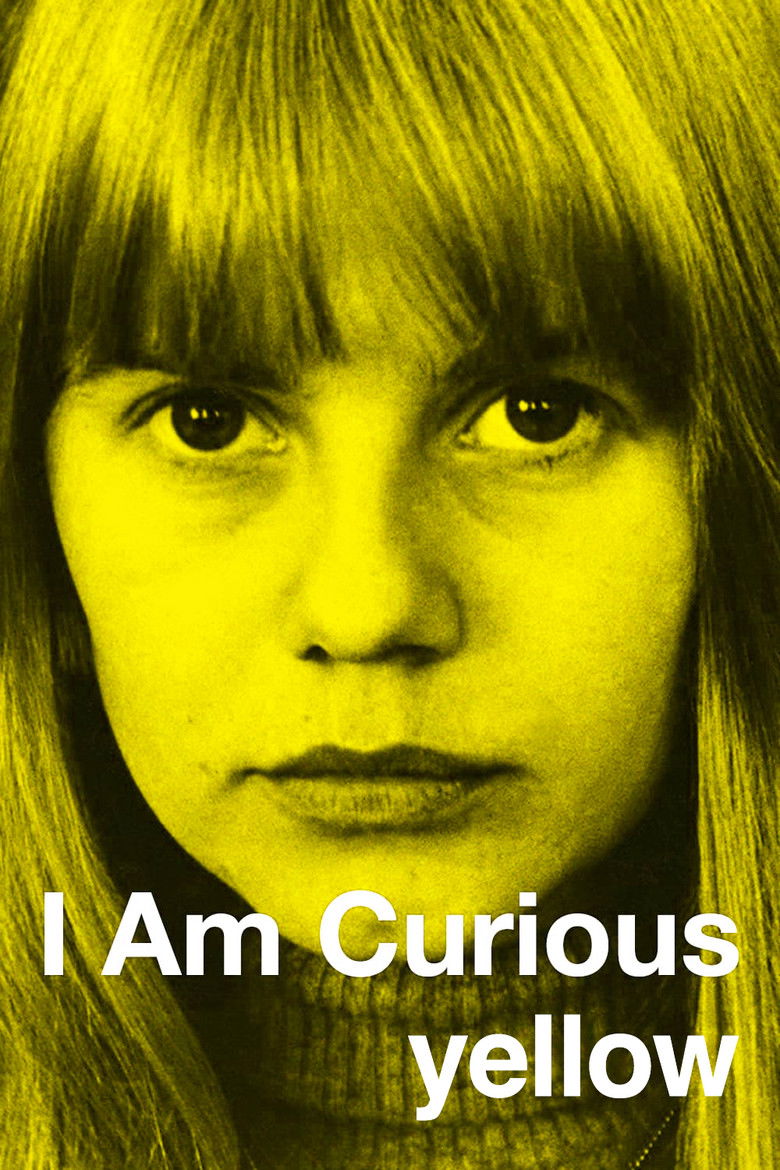
I Am Curious (Yellow) (1967)
A 20-year-old woman explores life, reality, and relationships amidst political drama. Ideal for fans of provocative, unconventional narratives.
Genres: Drama
Cast
- Cast member 1
- Cast member 2
- Cast member 3
- Cast member 4
- Cast member 5
- Cast member 6
- Cast member 7
- Cast member 8
- Cast member 9
- Cast member 10

Your Status
I Am Curious (Yellow)(1967)

Where to Watch
subscription


Overview
A young woman tries to understand life by interviewing people, collecting observations, and testing ideas through activism, meditation, and relationships. The film also keeps stepping back to show a playful, self-aware look at the cast and crew making the movie, mixing personal exploration with pointed social and political questions.
Insights
Review Summary
Pros: bold social questions; unusual self-aware structure; historically provocative | Cons: meandering and confusing; can feel pretentious; explicit sex and nudity
Will You Like This?
You may like this if you’re curious about boundary-pushing 1960s social debate, frank sexuality, and a film that comments on its own making; Not for you if you want a clear, fast story or minimal explicit content, like in CQ.
My Friends' Ratings
None of your friends have rated this yet.
Cast
Full Cast & CrewFeatured Comments/Tips
Those times when utopia was possible
The original title of the film is Jag är nyfiken - en film i gult.
Featured User Reviews

In the 1960s Sweden underwent an enormous social upheaval, which brought it from a rather rigidly stratified and staid society, which cinephiles might have seen in Ingmar Bergman's earliest films, to a place where the old sexual taboos collapsed and angry class war broke out just like in some other Western European countries. The Swedish filmmaker Vilgot Sjöman decided to reflect those changing mores (and possibly spur some further more-changing himself) with his pseudo-documentary project <i>I am Curious</i>. He developed a script through a great deal of improvisation and then shot enough footage to release it as two films: "Yellow" in 1967, and "Blue" the following year (these titles refer to the colours of the Swedish flag). This review treats both of them. The main actress of these films was 22 year-old Lena Nyman who plays... Lena Nyman, a 22 year-old drama student already well into sexual exploration and political commitment. From the home she shares with her alcoholic father, she runs what she calls the Nyman Institute, keeping an enormous collection of files and wandering around Sweden with a microphone to record the reactions of Swedes to provocative questions like "Does Sweden have a class system?" and (to holidaymakers returning from fascist Spain) "What do you think about Franco?". She has tumultuous relationships, mainly sexual, with suave yuppie Börje (Börje Ahlstedt) and idealistic bohemian Hasse (Hans Hellberg). The films have another layer, however, where we see Vilgot Sjöman coaching his actors and establishing a sexual relationship with his lead actress -- but even this layer is fictional. One really admires everyone, director and his actors alike, for being able to play fictional versions of themselves at two different levels. The two films have a yin-yang relationship, covering roughly the same themes but in different proportions. Yellow is more about political engagement and non-violence in the context of the Cold War, and it attacks the hypocrisy of the Swedish left (which had become entrenched and no longer a force for social change) and the monarchy. That film is set mainly in Stockholm and deals with Lena's home life. Blue, on the other hand, explores the themes of religion and the prison system, and more of it is set in the countryside where we hear some of the attitudes of rural Sweden as opposed to the capital. Upon their release, these films (especially Yellow) were attacked as pornography, and Sjöman as a letch (even though it was the real-life Nyman's idea that there be a subplot where the director seduces his lead actress). However, the sex and nudity here is not titillating at all, rather it is simply one of the many sociocultural themes that Sjöman wanted to present and as unsexy as any real documentary. Furthermore, Sjöman was really no letch at all -- among countercultural artists, he may have been ahead of his time in confronting the possibility that the new permissiveness wasn't just female liberation, it was also men finding it easier to coerce women into sex by accusing them of being uptight if they didn't put out, something which didn't occur to many 1960s idealists until the next decade. Another way in which Sjöman critically examines the New Left is by charting how those who preach non-violence could be very cruel in their interpersonal relationships with friends and family. I had seen only Yellow a few times and was prepared to consider this only a four-star deal, highly interesting as documentary material about 1960s Sweden, but missing something that truly moved me. However, getting a DVD set and finally seeing Blue provided that moving experience; it is quite impressive how Sjöman made the two films interlock with just enough overlap to make it a convincing whole. There's also some latent humour that becomes clear only on seeing both.