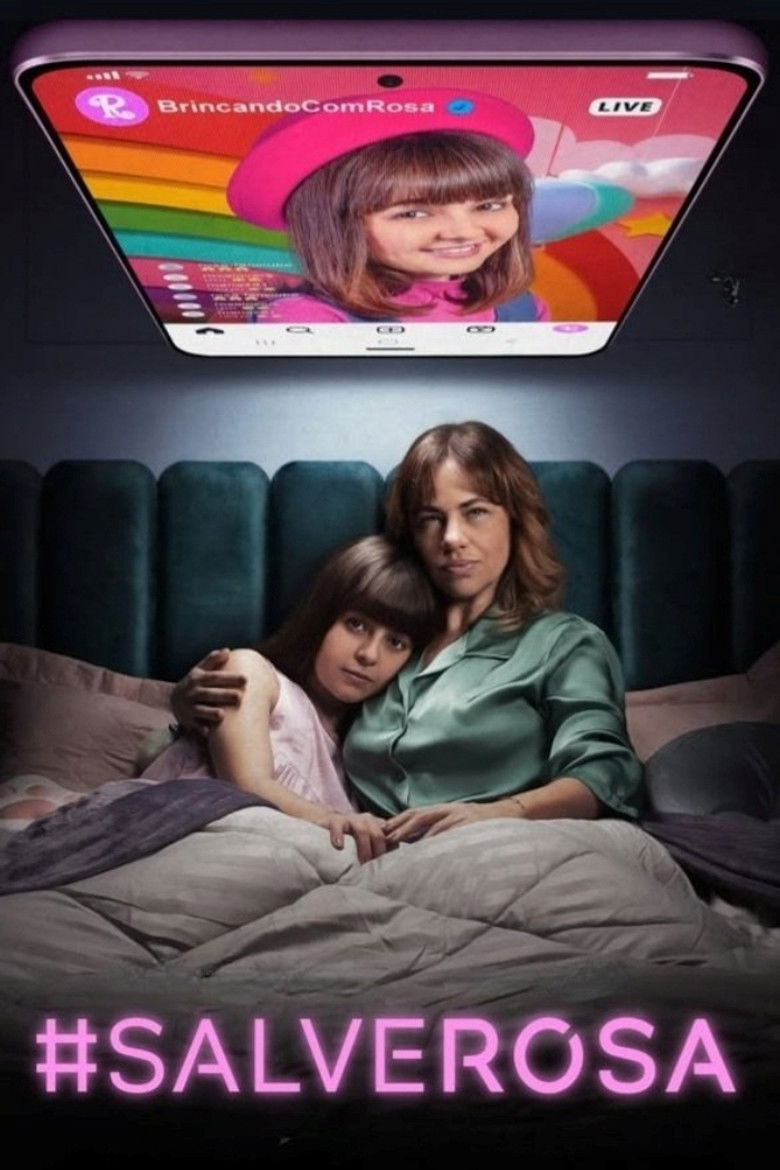
#SaveRosa (2025)
Thriller for mystery lovers: An influencer unravels life-altering secrets from her past that threaten her family bonds and safety.
Genres: Thriller, Drama
Cast
- Cast member 1
- Cast member 2
- Cast member 3
- Cast member 4
- Cast member 5
- Cast member 6
- Cast member 7
- Cast member 8
Your Status
#SaveRosa(2025)

Where to Watch
Overview
After fainting at school, a young influencer starts digging into her own past. As she follows the clues, her carefully managed online life begins to crack, straining her bond with an overprotective parent and putting her safety at risk.
Insights
Review Summary
Pros: timely social media critique; strong central performance; thoughtful teen perspective | Cons: uneven pacing; thin supporting characters; scattered subplots
Will You Like This?
You may enjoy this if you like modern dramas about online identity and family pressure, with a serious look at how visibility can harm young people, like Rivers of Fate; Not for you if you need tight plotting and fully developed side characters.
My Friends' Ratings
None of your friends have rated this yet.
Cast
Full Cast & CrewFeatured Comments/Tips
None of your fellow streamers have left comments/tips yet.
Featured User Reviews

“#SalveRosa” starts from a very contemporary premise, centered on how lives shaped by social media create artificial realities, distort relationships, and turn intimate experiences into consumable products. The film clearly understands this territory, pointing out how the internet has stopped being just a space for connection and turned into a commodified stage where identity and visibility walk hand in hand. It’s a relevant, necessary, deeply modern discussion, especially when it involves childhood and adolescence. The problem is that the thematic strength behind the idea doesn’t translate into the execution, and it’s exactly in that gap between intention and realization that the film starts to weaken. The script struggles to structure dramatic progression and organize character arcs, which hurts the narrative’s solidity early on. Many supporting characters show up as functional figures rather than fully developed people, limiting the emotional weight of the relationships around the protagonist. There’s a recurring sense that several storylines could’ve been explored with more care but remain stuck on the surface, as if the film introduces conflicts without really wanting to mature them. That lack of depth weakens the dramatic universe and makes certain events feel predictable or emotionally irrelevant. This limitation becomes even clearer in the construction of Dora. Karine Teles brings intensity to the role, but the script doesn’t give her the same support, resulting in an antagonist built more on schematic traits than real human contradictions. The character has a manipulative aura that could’ve led to something complex, but the writing keeps her stuck in a one-dimensional space, never digging into her motivations or offering concrete clues about her choices. Key questions are left hanging. Why does she lie? What drives her unstable relationships? What actually moves her internally? That absence of depth weakens the central conflict, because a thin antagonist shrinks the emotional reach of the story. In contrast, Rosa receives much more careful treatment and ends up as the film’s emotional anchor, largely thanks to Klara Castanho. She builds a believable character by balancing fragility and strength in a natural way, avoiding caricature and leaning into emotional nuance. The performance carries moments where the film gets closer to something stronger, especially when it slows down to observe the protagonist’s subjective experience under the invisible but constant pressure of digital exposure. Castanho manages to convey innocence, fear, and a deep desire to belong all at once, and that layered work gives the movie its most grounded emotional beats. Still, a strong protagonist isn’t enough to sustain a film with recurring structural gaps. The issue grows more visible when you look at the narrative environment surrounding Rosa. Several subplots are introduced without consistent development, creating a sense of fragmentation that prevents a solid emotional progression. Some elements feel promising but are dropped before gaining real dramatic relevance, contributing to a story that oscillates between strong intentions and scattered results. The film never quite establishes a clear axis of tension. The direction also fails to compensate for these structural weaknesses. Formally, it plays things too safe for a theme that would allow far more aesthetic boldness, especially considering the story directly deals with image, performance, and identity construction in digital environments. The staging is functional but rarely expressive, and the shot design relies on conventional solutions that don’t fully explore the visual potential of the world it wants to portray. Instead of translating the sensory impact of social media into cinematic language, the film sticks to a more neutral style, which creates a growing sense of distance. That distance deepens because several narrative elements are mentioned without receiving proportional development. Personal backstories are hinted at and then abandoned. Relationships appear without clear follow-through. It all reinforces the feeling that the film accumulates ideas without fully integrating them. The lack of cohesion between these dramatic lines prevents a consistent emotional curve, causing the narrative to dilute instead of intensify as it moves forward. By the time the story reaches the third act, these structural issues become even more evident. The pacing suddenly speeds up and starts compressing resolutions that would’ve needed more emotional groundwork. The ending feels rushed, like it’s trying to tie together conflicts that never had the time to mature, and that compression weakens the dramatic resonance. That said, the film isn’t without merit. Its critique of child exploitation in digital spaces remains sharp and relevant, showing an attentive eye for urgent issues, especially when it touches on how algorithms and adult interests shape young experiences. Whenever the narrative leans into that more intimate dimension, you can see flashes of a stronger film, one capable of balancing reflection and emotion more effectively. The problem is that those moments never solidify into a cohesive aesthetic and narrative whole. The result is a movie that constantly hovers between what it could’ve been and what it ultimately becomes, as if the power of the subject never finds a cinematic form strong enough to carry it. There’s a lack of depth where there was latent conflict, a lack of development where there was potential tension, and a lack of formal boldness where the theme demanded invention. “#SalveRosa” sparks reflection and raises important questions, but it also leaves a lingering sense of unrealized potential. It feels like a film that understands the urgency of what it wants to discuss but can’t translate that urgency into equivalent dramatic density and narrative rigor. The intention is relevant, but the construction doesn’t fully support the impact it aims for, and that mismatch ends up being its biggest weakness.